Wednesday, October 26, 2005

Overclocker Anonymous

"Hi, I am Anand kumar. I am an overclocker."

With the recent purchase of a Winchester core AMD64 3200+, I was impatient to learn the patient art of OverClocking your PC to the limit. After desperate brute force attacks on the various clock-related options via an utility, I was able to push the clock speed past the default clock to 2220MHz. This I acheieved by just increasing the core clock from 200 to 220MHz (with x10 multiplier). Other combinations didn't work, which, as I later found out, was because of the in-windows overclocking utility (Asus AI Booster) that kept crashing windows with clocks anything above 220MHz.

But later, after I got over the initial laziness to go through a few overclocking guides in a few forums, I finally acheived a much more respectable OC. Here'a a screen shot I made juat after a 2Million digits in SuperPI. For some reason, the SuperPI font is illegible, but the messagebox says that it went alright.


Before I plough on, here's the basics of OC'ing for the uninitialized:

- First, you need to get a motherboard and processor that allows you to OC. For example, in processors, an AMD Venice core OCs better than a winchester core, and in motherboards, an Asus A8NE OCs better than other motherboards while a DFI Lan Party motherboard is the holy grail of overclockers.

- Next, as I found out, get ram modules that has tight (low) timings and, possibly, with heat spreaders. For example, my cheapo Hynix ram running at 3-8-4-4 @ 200MHz can't stand a lot in the way of fsb clock whereas a Corsair/OCZ running at 2-5-2-2 has a lot of leeway.
- Having a clean and stable power supply unit also helps. Having a smps that has little in terms of fluctuations will help keep a stable processor at marginal voltages.

- A good, well ventillated cabinet can help keep the cool in ur processor. This is because, as u increase the clock speed of the components, they will require extra power for the signal to have the same impact when it was at a lower frequency. But cramming more power means more stray power that gets converted into unwanted heat. Most processors will operate without inexplicable auto-restarts and bewildering BSODs below 65degrees. The cooler you can keep it, the better.

After you have taken care of the preparatory phase, just increase the htt/core clock in steps of 5MHz and keep going till u hit a spot where the computer just plain refuses to POST. Now, if your board is overclocker friendly, it will let u access the bios settings no matter what, from which place you can revert back by 10MHz. Otherwise, you will have to open up your cabinet and reset the CMOS manually.
Now increase the VCore (cpu voltage) to the next number and try the htt increase. Anyways, 5MHz below unstable is the rule. Now, do the same with your ram by increasing your fsb by 5MHz. Increase VDimm (Ram voltage) if it doesn't post. But for Pete's sake (more like, for your computer's sake) keep an eye on temperatures. Be extra careful with ram voltages as any increase in ram temperatures cannot be noted. This is where the heat spreaders on ram modules can help, somewhat.

You can apply the above technique to your graphics accelerator as well. But 3D cards are especially notorious because they contain two cores: 2D core and 3D core. So when u OC in the 2D mode, the temps may be cool, but when you start that game, your GPU may BSOD or restart the core. The temp problem is very elusive too. That is, if u wanted to check the temp of the GPU while running a game,
by the time you ALT+Tabbed to the desktop to check the temp proggy's display, the temperature would've gone down by 10 to 20 deg C! They cool down extremely quickly. Most highend 3D cards operate above 90 deg Cand may reach 105 on a hot day. So be careful when u OC them. Testing each 5MHz with a benching utility like 3D Mark and checking for artifacts like snowing, missing textures and any out of the ordinary display, will help keep the cool in your card.
My NVIDIA GeForce 6600GT (Leadtek) was only able to do 550MHz core and 1100MHz memory. It could do more, but I kept this because the core and memory freqencies are in sync this way.

Now, you can either sit on your laurels here, or u can proceed from here. If you do want to proceed from here, you could try fine-tuning the cpu and memory clocks to acheive a perfect balance. You might also consider fitting your components with water blocks to reduce noise and temperatures. The rule for a fast computer is higher cpu clocks and not memory clocks.

I must've restarted more number of times that day than all the other days combined. But I don't seem to get any faster than 2500MHz. I had increased all the timings and freq to the max, but still the comp won't boot even at 2550MHz.
When I plan to increase the memory capacity of my system, I will be sure to buy a higher end brand with better timings, now that I've tasted OCing. I've heard Asus A8NEs having problem with 4 sticks of memory, so I will have to sell the existing sticks anyway and buy 2 sticks of 1GB each.

PS: For those interested in monetary details: (As of 01 June 2005)
My AMD 3200+ => Rs.9,800
Asus A8NE => Rs.7,600
Hynix 512MB => Rs.1,900
GForce 6600GT => Rs.10,000


(2ndSept05, 9:39PM)

Sunday, October 09, 2005

Of Meh, Meep and Bleh.

I am a great fan of bash.org and lately I am coming across a few foreign looking exclamations that seemed to be some kind of ultra-cliche among the IRCers and in the blogosphere. So I set out to find out about them but had difficulty googling them out because all occurences of these words were of their authors using them coversationally casually. So here's a small list with their possible meaning and an usage example in no particular order. Referred to the wiki and this and this site.


Meh:
A reply expressing unenthusiasm. I heard it said first by Lisa in The Simpsons. Then everywhere I looked, there was this word! Here's a discussion on this word's origin.
Usage:
- "Hey kids, do you want to go to the old age home?".
- "Meh."

Gah:
Exclaimation expressing dismay or unfortunateness. Sounds like it's come from the word 'bah'.
Usage:
- "Gah! Curse this lag!"

Blargh:
Exclaimation expressing uber anger, like that of a battle cry. Probably formed by melding Blah and Aaargh. I think it it describes a 'sputtering rage'.
Usage:
- "You are a st00pid n00b!".
- "Blargh! I am going to h4x0r you to death!".

Meep:
An exclaimation of fright, exaltation, anger or just about anything you feel at the time of usage :) But mostly when the utterer is surprised nastily. Sounds to that it was derived from the meek cry of a lamb.
Usage:
- "Muhahaha, all cower at my uber sniping skillz!".
- "Meep!".

Bleh:
An exclaimation used to express utter contempt along with a blatant boredom at doing something.
Usage:
- "Bleh! This work sux0rs!

Bah:
An exclamation of surprise and, especially, disgust. I've also seen it used as an expression of dismissal or rejection of an idea.
Usage:
- "They all so strongly believe that I will fail. Bah! I'll show them!".

D'oh!:
An exclamation said after realizing that you have said or done something stupid. It was invented by the makers of Homer simpson who cut short the syllable in 'duh' to make him say it quicker. Such was the popularity of the show that almost all the dictionaries have included this as a word to mean "annoyed grunt".
Usage:
- "Hey biatch, you've dropped your purse here!".
- "D'oh!".

Boob:
An dumb person. Someone with no brains and does nothing, just like the mammary sense of the word.
Usage:
- "Boob! You almost fubared my plan!"

Angst:
A feeling of self-pity, anxiety and mis-understoodness by others. Mostly referred to teens wallowing in their depression and complaining rather than taking any action.
Usage:
- "Gah, LiveJournal is overflowing with angst filled teenz."

FUBAR:
Also written as FooBar, it stands for Fu*ked/Fouled Up Beyond All Recognition/Repair. Originally a US military term where it was used to describe a mission's status quickly, it's "foo + bar" version has been used in computer field extensively for representing a two functions. This is perhaps the only non-sensical word that has become a metasyntactic variable and eventually to have it's own RFC!
Usage:
- "Heard about that accident? His car and body are fubar!"

Boo-Yah:
An exclamation of whooping when victorious in an argument or an event. I think it is a mutated version of "Oh yeah". Many spelling variations exists for this word: Boo-yea, Boo-ya, Boo-yeah and the like.
Usage:
- "Did u see me score that one? Boo-yah!"

Ping:
A quantum of happiness (?). People who are very 'Ping' are 'Pingful' and can exude ping others intentionally or unintentionally. It's the opposite of Blargh.
Usage:
- "Ping! I am so happy that I can die right now!".

W00t:
An exclamation expressing a whooping. This is supposed to be used by Dungeons and Dragons online RPG game addicts when they receive loot, while chatting, instead of "wow loot!".
Usage:
- "W00t! I won!".

pwned:
An exclamation used to describe someone you just beat in some competition of words or action, but especially in online multiplayer game. It is basically 'Owned' with a deliberate typo. It's origin is definetly of gaming backgrounds, but whether it is from warcraft or quake is unknown.
Usage:
- "pwned!!! Haha, what a n00b!"

Thursday, September 08, 2005

Roaming memory

It somehow and "somewhen"struck me to use the Internet as a storage medium when i first heard of the hop-by-hop translation of an Internet packet. I suppose that I supposed that I would just send my file into the Internet and make it hop around continously between the routers until such time when I needed that data, at which time I would just sorta "call'em home". It seemed simple and great. Later when I learnt of the TTl (Time To Live) fields in IP packets, my dreamed up Internet Memory of sorts seemed more plausible. I thought that if I could somehow fool the routers to accept a large TTL value, I could make the packet hop around for eternity (well, it didn't strike me why the Internet hasn't ground to a halt with too many packets doing infinite rounds). And when I wanted my packet, I would *somehow* make one of the routers in the loop to forward the packet to me on the next hop through it.

Reminiscing this old thought, I now feel that the above idea can work by using your own Routers in the loop, IP Source-Routing and a lot of hackish coding. No need for a TTL hack. But I don't exactly know if it would work yet. For example, the protocols may not allow a looped source routing, or the router may not respect the source routing (the RFC allows for this behaviour). U can avoid loops in routing by maintiaining two routers, with one router routing data to your other one, hence showing no loops in the routing. I haven't tried any of this, ofcourse. I don't have two routers for a start. And then there's the fact that I am not a Hacker. But I would be happy to know if someone had already done it or is planning to do it.

Moving on to the reasons behind how this "Memory" might work, only one word for you: DRAM. That's right, Dynamic RAM's working principle is the closest that U can analogize here. As u may know, in a DRAM, a memory location forgets what data it holds unless an internal circuitry "reminds" it of the data periodically. Forget to refresh it, and u've lost the data stored in there. But the important thing to notice here is that u don't need a second memory stick of the same capacity from which to refresh the DRAM. Also, the forgetfulness of the DRAM chip does not make us shirk it as a Main Memory in our computers. The reason that we even consider it is that it can remember what it is told for some quantum of time.
Comparing the memory to the Internet, I hope that you can see how it was easy to arrive at my conclusion that data can be stored by looping it around a known route. The Internet delay/latency, though being a dark gray pestilent cloud, has the silver lining of allowing the data to be temporarilly "lost" and then recovered back, thus replicating a temporary storage.

I am no great shakes with numbers, but if u take into consideration the following:
>input and output queue lengths and sizes of each box along the route,
>processing delay of each box,
> the Path-Length,
>Path-delay,
>the MTU of the path,
and coupled it with your own bandwidth, U can pretty much guess exactly how much you can store in this "Roaming Memory" (heh, had to mention it *somewhere*) of yours.

You could also be juggling many data packets at the same time, each packet travelling down it's own source-routed path. The number of such concurrent packets that your connection can handle can be easily calculated by knowing the data packet sizes, the amount of overhead associated with TCP/IP, ATM (if any) and anything else. Ofcourse, to have a larger memory, you can send different packets through each memory route, or for more robustness against packet loss(!) along a path, u can have a duplicate memory path for each packet.

Now to think of how actually you would call home a packet. First off, u can send in some ID code in each packet so that we can ask our router to retract in the right packet from the loop. Here comes the hackish coded application that I was talking about. This app will have to coordinate the packet routes, routing policy of the routers, setting a new packet of data in the loopy-motion, asking a router to retract a packet of the loop, putting different IDs on the packets, maintaining an ID-to-what it contains table and everything else I missed.

If u are perplexed as to why I should resort to such a twisted way of storage and why I didn't think of GDrive-like tactic of utilizing the email space, then u do have a point. But, since email follows the store-and-forward method of sending messages, you have a large delay. What my idea provides is a very low latency and high speed but a very small size memory. More like a cache memory in ur processor/mother board. Using GDrive-like idea will give u a very high latency, but large memory. Kinda like the main memory/hard disk in ur computer.

Friday, August 12, 2005

The Spiro collection - Making of


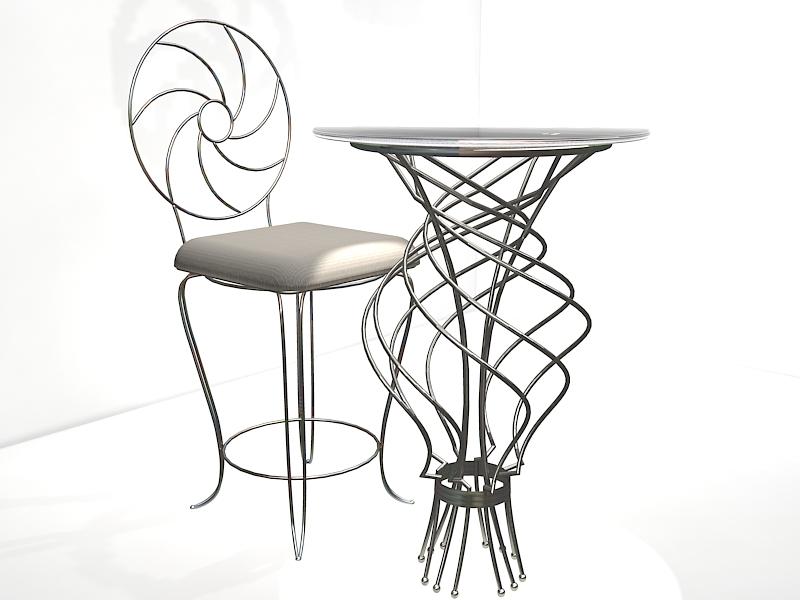
It's in no way a perfect render, but this was the 3d scene that I was referring to in my Zone post. This set was modeled by me which I did so by referring to this real world collection here. The collection consists of a Spiro Bar Stool, a Bistro (italian for pub) Table and a Spiro Tea cart. Found this one after googling for table sets images and loved the simple elegance.

I posted a small tutorial on this in a small forum because, though simple it is, the table seemed to be baffling to one of the members. So, I am posting the tutorial here too, incase someone reading this needed a pointer on how I made this. So here goes.

At first attempt, I struggled a lot not knowing how to create the table. Here's my preliminary attempt:

This picture, which is grossly wrong, was pretty difficult for me and was made as shown in this screenshot:
I first created "guide circles" (those scaled up circles in the side views.). Then in the front view I drew a line with as many vertices as there are guide circles from the bottom circle to the top one. Then in the top view I just moved the vertices of the line so that it conformed to each circle at different angles. It's kinda difficult to explain but I guess u will understand from this. This method was so tedious and error prone that I was struggling with it for more than an hour.

The later, more faithful, version of the table was made this way:

I just created the four inner, curved legs that u can see to set the scale of the table. Then I drew out a Helix on the top view and modified its height in the side view so that it forms a good shell over the four rods (For the helix parameters, see the above screenie). Then, I edited the helix at the bottom side to make it look more like the one in the reference photo. Since in the reference table there are 4 legs with two helix per leg, I rotated and cloned the helix 45deg seven times.
This method only took me 5 minutes to make this table.


Actually, the entire scene is made from lines (well, splines) that were given a renderable thickness value. It would've been difficult to the same with 3d solids.

For the material, I used the default Brushed metal. The rendering environment was set to uffizi_probe.hdr from debevec.org. If u had tried to learn to light a scene, you would've known that lighting is so tuff. So I didn't bother much with it. Just used one sunlight with final gather set to 700. This means you don't get to see sharp Caustics and control over shadows, but this method has, as I found out, the best mix of realism and speed.

For the cloth, I just used the default "carpttan.jpg" as diffuse and bump in an architectural material with template set to 'Fabric'. It is my default way of creating a cloth. For the cushion, I used a chamfered box with meshsmooth and a lot of fillet segments.

Hope it helped someone. (I know this is expecting too much as I don't have a lot of readership, but I've got to keep alive the hope.)

In da Zone.

I always lock myself in my room with my computer and very rarely go to that big room called "Outside", you know, the one with a very bright yellow-white bulb and lotsa concrete structures. (Infact, I must be the only kid in my friend circle who had the honour of his parents asking hopelessly to "go roam the streets"). Though I've started to go to a local Gym for some time now, I usually release my pent up energy by jumping, walking, running in-place in front of the mirror, or, if I am extremely annoyed/exhilarated, punch the walls in my bedroom with my knuckles a couple-a times.

The other day, I had just finished creating a 3D scene which I thought will inevitably join the list of unfinished 3d scenes. So I was euphoric, especially because the render turned out not-so-ugly too. So I was punching the wall a few times listening to iTunes, while I remembered my new gloves distributed in the Gym to aid in lifting barbels. I donned one on my right hand and punched once with my usual reserved force. This was when I made my mistake of thinking that the padding might protect me no matter what the force is. So there was I, punching with all my might into the wall a few times.

But was there pain then? Nope. There was no pain at all. This encouraged me to sock it to the wall a few more times. It's needless to say, I still have terrible pain over my knuckes though it's been a few days now. I don't know if they have cracked or not, but the color of the skin there has changed a bit to the darker side.

But wait, Why didn't I feel anything? Why did the pain wait for sometime to be felt? What was going on in my mind?

Here's another such experience in my life. When I was in sixth or seventh (I really don't remember) standard, I had joined a local karate class. I was attending this class for a year, I guess, and obtained an Orange belt. Shortly before my Master decided to start a new class somewhere else, he made us participate in a karate tournament. It was an awesome experience, needless to say. But I was throughly distraught at the possiblity of facing a well placed round-house kick from some of the l33t black belts there. I remember that in the first round, I sparred with an equally matched opponent. But I bet him by some points. This boosted my confidence to high levels.

In the second round, I was again sparring with someone of equal stature to me. Punches were exchanged and kicks were dealt. I was concentrating so much on landing left punches (of which I was famous for in my karate class) on my opponent that I had barely noticed any other thing. I heard no sound. I saw no faces peering from all around us. I saw no referee(or whatever he is called) moving close by us.I had no realization of whether I am within the sparring ring line that I was not supposed to cross. There was no nagging thought about home, doubt of losing, how bright the light is, what people are thinking about me right now, does my stature make me look awkward or not, etc. I was doing the only thing that I was supposed to be doing: defeat the opponent.

Then came the whistle.

This shook me up. Suddenly, as though someone has turned the master volume of the world up, the loudspeaker from the results of the sparring ring next to me, the cries of encouragement and suggestions to land a round-house kick from the eager crowd, the call of the referee towards him, plastic bags and covers crinkling as their owners took out snacks from them and everything else could suddenly be heard. My eyes too seemed to have suddenly recognized the world as if for the first time since I got there. The referee had called us because one of us had stepped out of the ring (i don't remember which one of us, clearly).

But the damage has been done. I feared that state of nothingness and actually felt a bit stupid. This loosened me up considerably and I lost to my opponent.


What is this state of automatic response by the body and mind to the present situation? I didn't know it then, but this is when psychologists say that you are "In the Zone".

What is this 'zone' thing? (And where are you when you are not in the zone?)

It is the state where your are performing automatically, kinda pre-programmed. Mostly, soldiers and athletes NEED to be in the zone. To give you a glimpse of what athletes and sports people experience when they are at their peak, take the everyday activity of brushing your teeth. For almost as long as you can remember, you have been brushing your teeth in the morning (and night, if you are unlike me). Now, can you think of someday when you have been on your way to your work and suddenly wonder whether you had brushed your teeth or not? Then there you go, you've been in the zone, albeit a smaller one than what hte atheletes occupy.

So being in the zone means that your body and mind are performing at their peak. You may think that it's certainly a good thing, and you won't be wrong. But how to acheive this state of harmony? Certainly not in an easy way.

Since your mind and body are involved, getting in the zone needs you to train them together. For the body, as hinted in the above example involving brushing, practising to the point of automation is the only way in. For the mind, you need to practice zen meditation. Don't worry, zen meditation, according to my Max Excel guide atleast, "is the easiest to do, although none of us practice". Zen means to "live in the present". In other smaller key word terms; concentration, feeling challengd, confident, being positive and calm.

How you acheive all those at the same time, is through another keyword: dedication. I guess it will be clear now why athletes seem like a well oiled machine at their activities. Writing an exam, computer gameing, driving a car, eating food (i guess), etc are some of the automatically programmed sequence of movements that we access, much like calling a pre-made function that can be called by the program. This is definetly faster and efficient than when it has to figure out a new way of doing it.
Perhaps your life was littered with such events and was bewildered like I was. Now, I guess, you know what it means.

(originally posted: Aug09)

Wednesday, August 10, 2005

A simple matter of Evolution.


Someone sent me this above picture among others for me to get a few laughs. Unfortunately, I couldn't decisively conclude on the author's message. So I let my right-brain run amuck and came up with a few good candidates for the author's intention. Here are some that I can come up with:

I guess this one's talking about stature of the depicted person (coz I don't believe that everyone's using computer in that particular way) which has returned back to the one characteristic of the primate to the extreme left.

Another way of interpreting this would be that the mobility of human beings is on the decline. (I can imagine an AD with the above picture and another one below it depicting the latest human using a palmtop standing straight and walking around as well, as a promotion for palmtops.)

Or maybe the picture is depicting a world where humans evolved but chose not to wear anything, even after reaching the info age, and the words below as saying that something on earth went wrong because we on earth wear clothes. (Maybe an AD for a Nudist Club?)

Or, maybe the author is all for a hairy guy and wonders what went wrong as the humans got lesser and lesser hair coat than the chimps.

Or, maybe it is talking about the too abrupt shift from Hard tools (spear, jackhammer, etc) to soft tools like the computer, and the comment can be taken to be wondering what made the sudden shift.


Perhaps the real meaning is not for me to know :)
I guess I have too much free time.